Våg
 Mulet
 Torg
 Cirkus
 Frost
 Fajans
 bitte
 Glänta
 Ståmp
 blur
 Terre
 RIMs
 Root
 It
 Chroma
BRAND, SELECT, Staff favourites, About Tableware, Journal, Gifts
The Making of Cutipol
Have you come across Cutipol?
Cutipol is a Portuguese cutlery brand with admirers in Japan and around the world.
Perhaps you have seen its pieces online, or already use them at home. Here we take a closer look at the history and craftsmanship behind the familiar designs.
1. About Cutipol
2. What passes from one generation to the next
3. Design development and handwork
4. Attention to the details
5. The Goa collection
6. A final thought

1. About Cutipol
Cutipol comes from the Guimarães region of northern Portugal, near Braga. Its roots lie in the Ribeiro family's cutlery-making tradition, passed from an earlier workshop to the company founded by José Ribeiro.
The Cutipol brand was formally established in 1963, with a name chosen with international customers in mind.
The family developed the business through new designs and finishes, gradually shaping the Cutipol known today.

2. What passes from one generation to the next
Family continuity is an important part of Cutipol's story.
That continuity extends to the workshop, where skills and experience have also passed between generations and family members.
It is not only technique that is handed down, but also a sense of pride and an understanding of what makes the work distinctive.

3. Design development and handwork
An idea begins with a designer's sketch. Experienced craftspeople interpret it in a prototype, working closely with the designer to refine the shape. Long-standing trust makes that exchange possible.
Modern machinery plays a part, but skilled handwork remains important in achieving the forms and finishes the designers intend.
Prototypes are repeatedly assessed for weight, balance and comfort in use. Some ideas are set aside, while others are refined through further trials before becoming a finished design.

4. Attention to the details
Here are four aspects of Cutipol's approach that particularly interest us.

1. Skilled handwork
Making cutlery involves many stages, with craftspeople handling and checking the pieces throughout the process.
Careful shaping and polishing help achieve the slender curves, long fork tines and refined finish that characterize the cutlery.

2. Original design and production
Design and production take place within the company's Portuguese operation, which also develops some of its own tools and machinery.

3. Careful inspection
Inspectors check individual pieces against detailed criteria and report problems so that the production process can be improved.
This patient, repeated inspection helps maintain a consistent finish.

4. Considering environmental impact
The original feature also highlighted the company's use of solar power and other renewable electricity in production. Energy sourcing can change over time, so this historical account should not be treated as a current certification or fixed energy mix.

5. The Goa collection
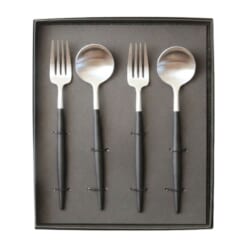
Goa combines slender lines with a carefully considered balance in the hand. Its shape is designed to make cutting, lifting and serving food feel comfortable, while bringing a light visual touch to the table.
Goa combines stainless steel with resin handles. The 18/10 designation refers to roughly 18% chromium and 10% nickel in an iron-based alloy, not copper. Knife blades may use a different steel suited to cutting. Wash and dry the pieces carefully to maintain their finish.
Cutipol permits dishwasher use subject to its care instructions. Handwashing is recommended in hard-water areas. Clean food residue promptly, use a suitable mild detergent and dry the pieces after washing.
Avoid prolonged exposure to hot dishwasher steam; remove the cutlery when the cycle ends and dry it with a soft cloth.
Space the pieces apart to prevent contact scratches rather than crowding them together.
Take particular care with gold finishes, and avoid abrasive tools or contact that may damage the coating.
These points are a brief guide. Follow the care instructions supplied with your particular finish and the manufacturer's full guidance; they are not a guarantee against damage.
Goa is practical at the table and pairs easily with many kinds of tableware, including delicate Japanese ceramics.

6. A final thought
Whether Cutipol is new to you or already familiar, we hope this look behind the designs adds to your enjoyment of the brand.
Cutlery is used often and may stay with us for years. Although it can seem like a supporting detail, a design chosen with care can bring a different feeling to everyday meals.
Try adding Cutipol to your table and enjoy the difference a small detail can make.