Våg
 Mulet
 Torg
 Cirkus
 Frost
 Fajans
 bitte
 Glänta
 Ståmp
 blur
 Terre
 RIMs
 Root
 It
 Chroma
BRAND, POTPURRI, Staff favourites, About Tableware, Journal
POTPURRI's Commitment to Fajans
NOV. 2022
“I started POTPURRI because I wanted to make faience.”
POTPURRI founder Hiroyuki Okami sometimes puts it this way:
What makes Stig Lindberg's faience so compelling? What might faience mean for everyday life today? Here is the story behind POTPURRI's Fajans collection and why we continue to develop it.

1. Stig Lindberg and faience
2. What is POTPURRI Fajans?
3. How Hiroyuki Okami encountered faience
4. The modern faience POTPURRI wanted to make
5. A collection that keeps evolving

Stig Lindberg and faience
The word faience may be unfamiliar to many people in Japan.
In the European ceramic tradition discussed here, faience refers to earthenware with an opaque, usually white, tin glaze. It can be made with different clay bodies; the glazed surface provides a ground for decoration.
As industrial production expanded in the twentieth century, traditional faience faced competition from inexpensive ceramics. Lindberg brought renewed attention to its expressive possibilities.
Stig Lindberg (1916–1982) was one of Sweden's leading mid-century designers. At Gustavsberg, he created many celebrated ceramic designs that continue to attract collectors and admirers.
Known for his inventive designs, Lindberg used vivid color and bold forms to give faience a distinctive new presence in modern ceramics.
For many admirers of Scandinavian ceramics, the word faience has become closely associated with Lindberg's vivid work.

What is POTPURRI Fajans?
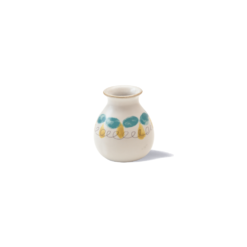
POTPURRI's Fajans collection was inspired by Lindberg's faience, but incorporates different materials and methods to suit everyday life today.
Microwave and dishwasher safe
Traditional low-fired faience has a relatively porous body. POTPURRI reconsidered the clay and glaze from the beginning, developing a higher-fired body suitable for the microwave and dishwasher while retaining the desired visual warmth.
Resists scratching from cutlery
Decoration applied over the glaze can wear through contact with metal cutlery and years of use. To help protect the designs, POTPURRI developed a method that places the color beneath the surface glaze.
An accessible price
Lindberg's faience was individually painted by craftspeople. For its regular Fajans collection, POTPURRI uses screen-printed transfers applied to the ceramic body and fired into the surface. This helps maintain consistent quality and a manageable price. Many tests were needed to preserve the feeling of the original hand-drawn artwork.
These ambitions meant that many years passed between the first experiments and the collection's introduction. Research has continued since then, alongside seasonal hand-painted editions.
We spoke with designer Hiroyuki Okami about where that enthusiasm began and what faience means to him.

How Hiroyuki Okami encountered faience
Okami first encountered faience at about twenty-one, in the Book First shop in Shibuya. A member of his university's ceramics club, he noticed the brightly colored pottery on the cover of a book about Stig Lindberg. The cover showed a piece of faience.
Until then, he had mainly made Japanese-style pieces using Shino, Oribe and yellow Seto glazes. Faience's bright colors made a strong impression, and he became curious about how it was made. As a student, however, his attempts to reproduce the colors and brushwork did not yet give the results he imagined.
Another encounter then drew him even closer to Lindberg's work.
At the time, Okami admired the world and working attitude of Jun Takahashi, the designer behind UNDERCOVER. In a magazine photograph of Takahashi's office, he noticed a Lindberg ashtray.
He had often wondered whether ceramics could express something of music and fashion. Seeing Lindberg's work at home in an office shaped by fashion and rock music drew him further toward it.

After graduating from university, Okami traveled to Sweden to look for work in ceramics.
Okami visited Gustavsberg, where Lindberg had worked, but found that the operation had become smaller and was not developing new pieces at the time of his visit. He also visited other potteries and makers, looking for the variety and charm that had drawn him to Lindberg. Eventually, he joined a Japanese pottery that had been highly regarded by people he met in Sweden.
Traveling through Sweden, he saw original faience at the porcelain museum in Gustavsberg. Encountering its colors and sculptural forms in person strengthened his wish to make his own.
While learning at a Japanese pottery, he continued his own experiments with faience. Deciding that he needed to take responsibility for the work and its risks himself, he established POTPURRI.
The modern faience POTPURRI wanted to make
Okami did not intend to reproduce Lindberg's faience exactly. Historic mid-century pieces were not made for microwave or dishwasher use, and he wanted a collection that would fit the routines of a contemporary kitchen.
Research began into ways to retain the surface character of Lindberg's faience while creating stronger tableware suited to present-day use.

The first challenge was the surface texture.
The aim was a white that was not too stark, with a matte surface that was not too flat—a delicate balance of qualities.
The red clay, the base glaze that gives just the right matte finish, and the firing schedule must all work together. Even a small mismatch changes the result.
We tested many combinations of red clay, base glaze and firing schedules, learning through repeated failures.

Another major challenge was transferring the painted designs.
The Fajans transfer sheets use ten layers of screen printing to reproduce the variations in strength and tone of a painted brushstroke.
We can now account for color changes during firing and layer the printed transfers to achieve the intended effect. Getting there took countless prototypes: sometimes the decoration did not suit the clay surface, and sometimes the brushlike marks did not come through clearly.
After working through these challenges, a Fajans collection close to the original vision was completed three years after POTPURRI began.
A collection that keeps evolving
From the beginning, Fajans was conceived as an open-ended project. Most POTPURRI collections settle into their established form after launch, but Fajans remains an exception.
Lindberg's hand-painted faience varies from piece to piece, even within the same pattern. POTPURRI continues to explore how to bring a comparable sense of character to pieces that can be produced consistently and offered at a more accessible price.
For Okami, neither the current shapes nor the current patterns are a final answer. Fajans is intended to keep evolving.
Limited editions of individually hand-painted Fajans are one part of that continuing exploration.
Each design captures the feeling of the moment in which it was painted. Every piece is an individual encounter.
Okami often notices simple, single-color objects in Japanese homes. He hopes Fajans will invite people to enjoy an accent of color among those familiar basics.
We hope Fajans brings a touch of colour to your life and a little more pleasure to your table.
We look forward to sharing the next chapters of Fajans with you.